


Private Caregiver vs Senior Care Home
- Serenity Springs Senior Living
- Jun 18
- 6 min read

A fall at 2 a.m. changes the conversation fast. So does a missed medication, wandering, or the moment a spouse realizes they can no longer manage bathing, meals, and appointments alone. When families start weighing private caregiver vs senior care home options, they are usually not making an abstract lifestyle choice. They are trying to protect someone they love while preserving dignity, comfort, and as much independence as possible.
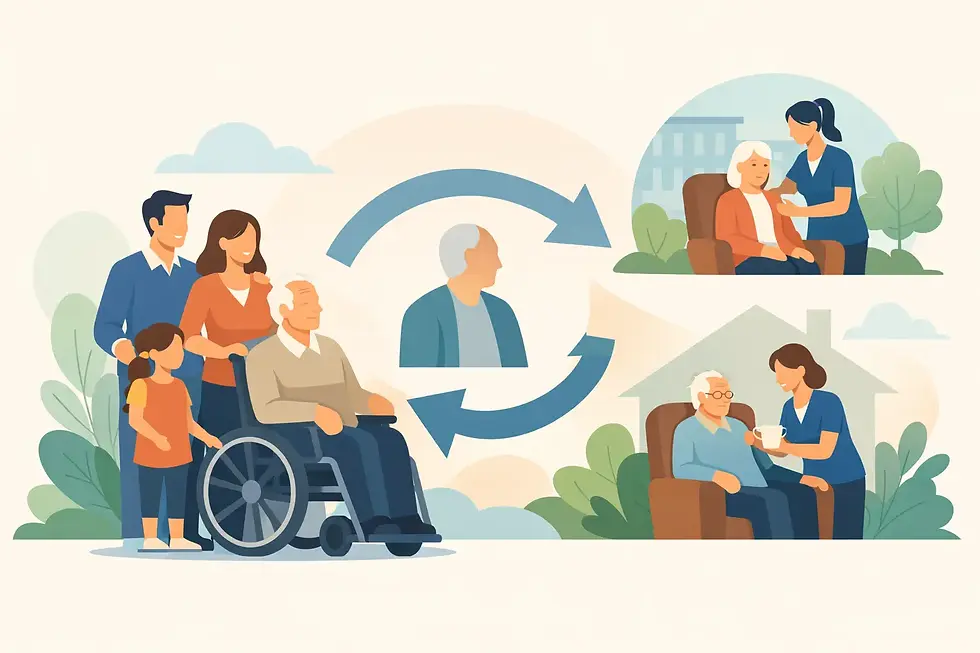
The right answer depends on your loved one’s health needs, personality, home environment, and the level of oversight required day and night. Both options can be appropriate. The difference is in how care is delivered, how consistently it is available, and how much responsibility remains on the family.
Private caregiver vs senior care home: the core difference
A private caregiver typically provides support in the older adult’s own home. That may include help with bathing, dressing, meals, light housekeeping, companionship, transportation, and reminders. For some families, this feels like the least disruptive option because the senior remains in familiar surroundings.
A senior care home provides care in a residential setting designed around older adults’ daily needs. In a high-touch residential model, support is built into the environment itself. That can include 24/7 supervision, medication management, fall prevention, mobility assistance, meals, social engagement, and closer wellness oversight.
On the surface, the question can sound like home versus not home. In practice, it is more about whether your loved one needs periodic help or an environment where care is continuously available.
When a private caregiver makes sense
A private caregiver can be a very good fit for seniors who are still relatively stable and safe at home. If your parent needs help a few hours a day with meals, bathing, errands, or companionship, in-home support may be enough. It can also work well after a hospital discharge when someone needs short-term help during recovery.
There is real emotional value in staying in a familiar house, sleeping in the same bedroom, and keeping established routines. For seniors who become anxious with change, that familiarity matters. It may also feel more personal to have one consistent caregiver rather than moving into a new care setting.
That said, in-home care often works best when family members are still carrying part of the load. Someone usually has to coordinate schedules, monitor changes in condition, manage backup plans if a caregiver is unavailable, oversee medications, and step in after hours. If the senior’s needs begin to increase, what started as a manageable arrangement can become fragile very quickly.
The limits families often discover later
Private caregiving sounds simple until care needs extend beyond daytime help. If a loved one wakes up confused at night, needs frequent toileting assistance, forgets to use a walker, or has dementia-related behaviors, a caregiver who comes for a few hours a day may not be enough.
To cover true around-the-clock care at home, families often need multiple caregivers rotating in shifts. That can become expensive, difficult to coordinate, and inconsistent from one person to the next. Even in the best arrangement, the home itself may still present risks such as stairs, narrow bathrooms, poor lighting, or isolation during overnight hours.
When a senior care home is the safer choice
A senior care home is often the better fit when care needs are no longer occasional. If your loved one needs ongoing help with activities of daily living, medication oversight, mobility support, memory care, or supervision throughout the day and night, a residential care setting usually offers more stability.
This is especially true for families dealing with repeated falls, increasing confusion, incontinence, caregiver burnout, or a recent hospitalization that revealed how vulnerable the senior has become at home. In those moments, the goal is not just convenience. It is reducing risk.
A quality residential care home can also provide something many families underestimate at first: continuity. Instead of piecing together support from different people and schedules, care is organized through one setting, one plan, and one team. That consistency often improves both safety and peace of mind.
Why the setting itself matters
In a well-run residential care home, the environment supports care. Staff are nearby. Meals are prepared. Medication routines are monitored. Transfers and mobility can be observed more closely. Changes in appetite, cognition, balance, or mood are easier to notice because someone is present regularly, not dropping in for short visits.
For seniors with memory decline or frailty, this level of observation can be critical. Small warning signs are often what prevent larger crises.
Comparing cost beyond the hourly rate
Cost is one of the biggest reasons families hesitate. A private caregiver may look more affordable at first, especially if your loved one only needs a few hours of help each week. But as needs increase, the math changes.
Hourly care can add up quickly when support is needed mornings, evenings, weekends, or overnight. Families may also still be paying for mortgage or rent, utilities, groceries, home maintenance, and safety modifications. If multiple caregivers are needed to cover all hours, total costs can rise beyond what many expect.
A senior care home often has a higher visible monthly price, but that number may include much more: accommodations, meals, personal care, medication management, housekeeping, laundry, supervision, and daily oversight. For families who value pricing clarity, an all-inclusive residential model can feel more predictable than trying to budget for layers of in-home support.
The real question is not which option has the lower starting price. It is which option delivers the level of care your loved one actually needs without leaving dangerous gaps.
The emotional side of the decision
Many families feel guilty even considering a move out of the home. That reaction is understandable. Home carries meaning, history, and identity. Adult children often promise they will do everything possible to keep a parent there.
But love and safety are not opposites. Sometimes the most compassionate choice is not the one that preserves the old routine. It is the one that protects health, reduces stress, and gives the senior more support than family alone can provide.
It also helps to separate the idea of a large institutional facility from a more intimate residential care home. Not every senior care setting feels clinical or impersonal. A boutique care home can offer a quieter, more familiar atmosphere while still providing professional oversight, personalized care plans, and a stronger safety net than most private homes can support.
Questions that make the decision clearer
If you are stuck between the two options, look closely at what happens during the hours when no one is present. Is your loved one safe getting to the bathroom? Are medications taken correctly every time? Is there wandering, sundowning, weakness, or poor appetite? Has one fall turned into two or three? Is a spouse becoming exhausted?
Those are not small details. They usually point to the level of care required.
You should also consider how much coordination your family can realistically sustain. Some families have the time, proximity, and support system to manage in-home care well. Others are juggling careers, children, travel, and constant worry. A care plan only works if it is dependable in real life, not just on paper.
Private caregiver vs senior care home for memory care and complex needs
When dementia, Parkinson’s, stroke recovery, or multiple chronic conditions are involved, private caregiver vs senior care home decisions become more clinically important. A senior with memory loss may seem fine for part of the day and still be unsafe alone. Someone recovering from illness may need close monitoring for mobility changes, hydration, skin integrity, or medication side effects.
In these cases, families often benefit from a residential setting with stronger supervision and a care team that can notice subtle changes early. Nurse-supervised care, structured routines, and owner-led oversight can make a meaningful difference when needs are evolving.
For families in Cypress and nearby communities, this is often where a smaller residential model stands apart. It can feel warm and personal while still offering the consistency, accountability, and clinical attention that more complex situations require.
At Serenity Springs Senior Living, that balance is central to the care experience: an intimate home-like setting paired with 24/7 nurse-supervised support designed to protect dignity as much as safety.
The best choice is the one that fits your loved one as they are now, not as they were six months ago. If home still feels safe with limited help, a private caregiver may be the right next step. If care needs are growing, nights are becoming risky, or the family is stretched thin, a senior care home may offer the steadier path forward.
A good care decision should not leave you wondering who is there when something goes wrong. It should let your loved one be cared for with warmth, professionalism, and the kind of daily attention that helps everyone breathe easier.


Comments